A lightweight G-code interpreter written in C++ inspired by the NIST rs274ngc interpreter.
The output of the interpreter may be used to drive 3-axis machines.
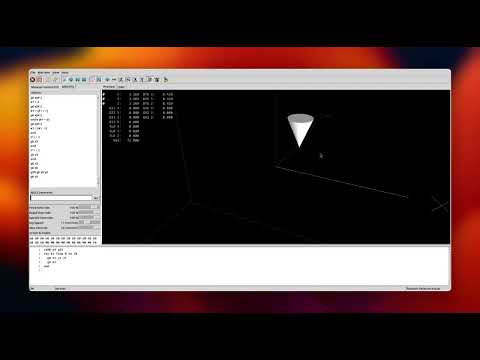
- Architecture - docs/ARCHITECTURE.md
- Language Features - docs/FEATURES.md
- Integration into LinuxCNC - /docs/INTEGRATION.md
- Any compiler for C++17 or later
make
make antlr
make dev
./build/gcode++ <filename>
By default, make install builds and installs the binary into /usr/local/bin.
make install # optional: `DIR=/usr/bin` or something
gcode++ <filename>
make test unit       # runs all unit tests
make test regression # regression tests
- Motion: G0, G1, G2, G3, G4
- Plane Select: G17, G18, G19
- Units: G20 (inches), G21 (millimeters)
- Positioning Modes: G90 (absolute), G91 (relative)
- Coordinate Systems: G10, G43, G54-G59, G92
- Feed Rate Modes: G93, G94, G95
- Spindle Modes: G96, G97
- Canned Cycles: G80, G81, G82, G83, G84, G85, G86, G87, G88, G89
- Retract Modes: G98, G99
- Spindle Control: M3, M4, M5, s
- Program Control: M0, M1, M2, M6, M98, M99, M100, M101+
- Feedrate: F
- More TODO...
If you want to make changes to the antlr grammar, Java is required
since make antlr depends on Java. You'll have to run make antlr to test as
well as build the binary.