
The Copilot Studio extension for Visual Studio Code is designed to enhance the development experience of Microsoft Copilot Studio agents. It provides language support, IntelliSense code completion and suggestions, and authoring capabilities for Copilot Studio agent components.
After installation, the extension prompts you to sign in to Copilot Studio. It can then show you a list of the agents associated with your environment. Clone an agent to see its editable components, including knowledge sources, actions, topics, and triggers.
This is a technology preview release. Preview releases are only available for Windows/x64 versions of Visual Studio Code.
-
Select the Copilot Studio icon in the primary side bar of Visual Studio Code. The extension asks for your permission to sign in.
-
Select Allow, and sign in with the appropriate credentials for your Copilot Studio environment.
-
(Optional) Open the desired agent in Copilot Studio and copy its URL from your browser's address bar.
-
In the Copilot Studio panel of Visual Studio Code, select Clone agent.
-
Select your agent (marked with "from clipboard" if you already copied the URL); otherwise, select the desired environment and then select the desired agent. The extension prompts you to select a folder to hold your agent's files (similar to a local repository).
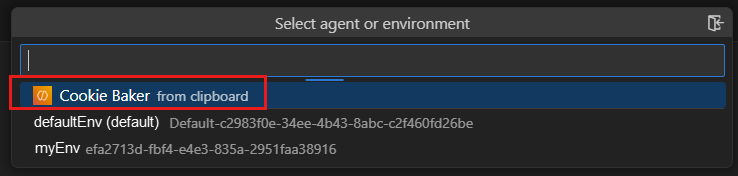
-
Select the desired folder.
To edit any component, open the corresponding file and make the desired changes. Since Visual Studio Code natively supports YAML files, the Copilot Studio extension supports IntelliSense code completion and can provide guided tips.
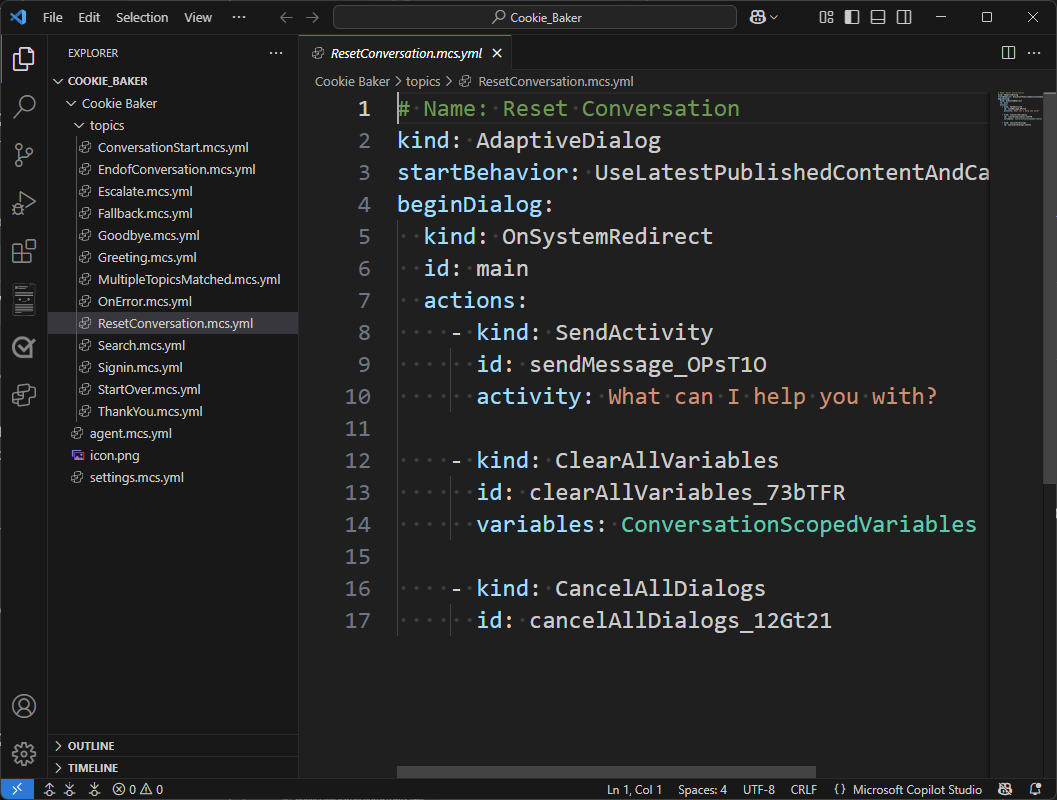
The Copilot Studio extension uses the same source control features as Visual Studio Code. Fetch changes, Pull changes, and Push changes icons are available in both the Explorer panel and the Source Control panel of Visual Studio Code.
- To preview any remote changes from Copilot Studio, use Fetch changes.
- To get all remote changes from Copilot Studio, use Pull changes.
- To push your local changes from Visual Studio Code to Copilot Studio, use Push changes.
When you push changes they are saved directly to Copilot Studio. This is different than having a local instance of the agent, which you would then deploy to Copilot Studio. The extension provides a live editing experience of a cloud resource.
To help us resolve problems more efficiently, please use the custom issue reporting command built into this extension. It automatically includes helpful diagnostic information like your session ID.
✅ Recommended: use the custom Help: Copilot Studio: Report Issue command
- Open the Command Palette (Ctrl+Shift+P or Cmd+Shift+P on macOS)
- Type and select: Help: Copilot Studio: Report Issue

- A form will appear with a pre-filled Session ID, fill out the form and submit. This ensures we receive context to investigate your issue quickly.
